The River Ganga (Ganges) Through the Lens of the Murli
“बच्चे बाप के बनते हैं तो बाप कहते हैं – बच्चे तुम्हारी आत्मा पतित है, पतित चल नहीं सकेंगे। यह समझने की बातें हैं।”
“When you children belong to the Father, He says: Children, you souls have become impure. You will not be able to return while you are impure. This is something to be understood.”
“धर्म स्थापन करने वाले जो आते हैं उनकी आत्मायें पवित्र होती हैं। पुरानी पतित आत्मा धर्म स्थापन कर न सके। तुम धर्म स्थापन नहीं करते हो, शिवबाबा तुम्हारे द्वारा करते हैं। तुमको पवित्र बनाते हैं।”
“The souls of the founders who come to establish religions are pure. Old, impure souls cannot establish a religion. You do not establish a religion. Shiv Baba does that through you and He makes you pure.”
Murli: 14th August 2026
Strangely these lines from today’s Murli prompted me to reflect, at a much deeper level, on the ancient story of the origin and descent of the River Ganga, or Ganges.
The River Ganga is regarded as sacred in Hinduism. Millions of devotees revere Ganga as Mother (Maa) Ganga and traditionally believe that bathing in her sacred waters can purify them of their sins, vices and impurities.
Here is something that many BKs or Raja Yogis may find intriguing. According to Hindu scriptures, the sacred Ganga is said to have descended from the heavens, originating from the feet of Vishnu (Narayan), and to have been held by Lord Shiva before flowing onto Earth. The Valmiki Ramayana provides a particularly intriguing detail: Lord Shiva subsequently released her towards a place called Bindu Sarovar. The word bindu means ‘a point’, while sarovara means ‘a lake’. Thus at a contemplative level, one might view Bindu Sarovar symbolically as the ‘Lake of the Divine Point.’
From a BK perspective, one might contemplate whether this could symbolically refer to the first Narayan at the beginning of the world cycle, with Ganga subsequently flowing through Lord Shiva and being released towards Bindu Sarovar – the symbolic ‘Lake of the Divine Point’ to purify the fallen souls.
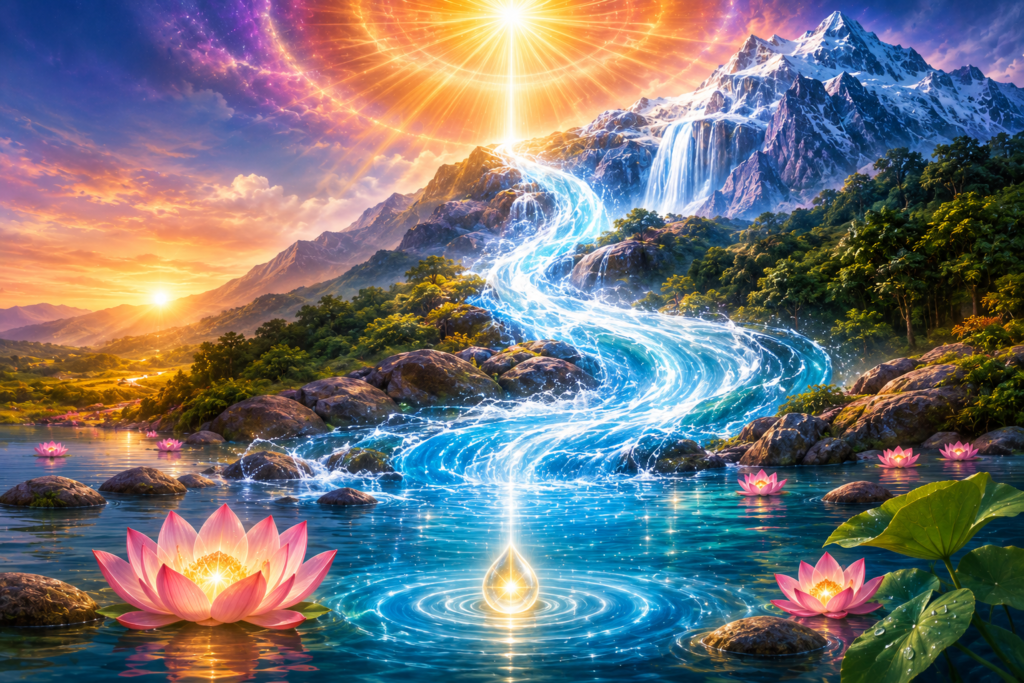
Like many ancient scriptural narratives, could this story perhaps be pointing towards a deeper spiritual or metaphysical reality rather than merely describing a physical event?
We often find references to the River Ganga in the Murlis. Could the word Ganga itself be a symbolic metaphor for Divine Knowledge – a stream of Divine Knowledge descending from the Supreme Source (Shiv Baba) and flowing into the human soul – the point of light, which then purifies the fallen souls.
Perhaps these ancient narratives are not merely stories about rivers, mountains, deities and Gods. Perhaps they are metaphors or symbolic narratives encoding ideas about consciousness, knowledge, purity and the relationship between the Supreme Soul and the human soul.
Finally, it is worth mentioning here that there is also an interesting expression familiar in Indian spiritual discourses called “Gyaan Ganga” – the ever-flowing stream of Divine Knowledge. Just as the physical river Ganga is traditionally believed to purify those who bathe in her sacred waters, could the phrase ‘Gyaan Ganga’ offer a better clue to a deeper symbolic understanding of the word Ganga – the flow of Divine Knowledge that purifies the soul of its sins, vices and impurities?